
Ubersuggest is one of the best-known SEO tools for keyword research, mainly thanks to its low entry price and Neil Patel's reputation. But once you really start using it, three limits quickly appear: the 3 searches per day on the free plan that vanish after five minutes of real research, keyword volumes that are often off compared to Google's real data, and an interface saturated with upsell pop-ups pushing Neil Patel's other products.
This article is published on the Horusium blog, so we won't hide behind fake neutrality: yes, Horusium is one of the alternatives I present, and it's even the one we stand behind. But for the comparison to be useful, I've included the 6 other serious tools on the market — free, freemium or subscription-based — with their real strengths and limits. The goal isn't to make you pick Horusium just because you're reading these lines: it's to give you what you need to choose the tool that fits your usage, and to explain why Horusium is our answer for French freelancers and consultants who don't want a monthly subscription.
Why look for an Ubersuggest alternative?
Before comparing the tools, we need to be honest about what's wrong with Ubersuggest. Three complaints come up almost every time from users who switch to something else:
- The free tier is too limited: 3 searches per day is a teaser, not real usage. You hit the limit before the end of your first research session.
- Data quality: keyword volumes and difficulty scores often diverge from the figures shown by Google Keyword Planner or Search Console. The backlink index is smaller than Ahrefs' or Semrush's. The site audit stays superficial.
- Cluttered UX: the dashboard is saturated with upsell pop-ups pushing Neil Patel's other products (courses, coaching, agency). It feels more like visiting a store than using a professional tool.
A good Ubersuggest alternative has to fix at least one of these three points: a genuinely usable free tier, better data, or a pricing model that doesn't force you to pay every month for usage that isn't monthly.
Comparison table of the 7 Ubersuggest alternatives
| Tool | Model | Keyword research | SEO audit | Backlinks | Best for |
|---|---|---|---|---|---|
| Horusium | Credits (no subscription) | Yes (up to 200 KW + 6 questions) | Yes (page + site SEO Health) | Partial | Freelancers, FR consultants, irregular usage |
| Google Search Console | Free forever | Your real Google data | Native indexing | Limited | Everyone, as a complement |
| Ahrefs Webmaster Tools | Free forever (verified sites) | Limited to owned sites | Yes (Site Audit) | Very complete | Site owners |
| Google Keyword Planner | Free (Google Ads account) | Volumes in ranges | No | No | Raw keyword research |
| Mangools | 10-day trial then $29/month | Yes (KWFinder) | Yes (SiteProfiler) | Yes (LinkMiner) | Beginners, clean-UI fans |
| SE Ranking | 14-day trial then $65/month | Yes | Yes (audit + rank tracking) | Yes | Small agencies, pro freelancers |
| Moz Free Tools | Free (10 queries/month) | Very limited | Partial | Yes (DA) | Occasional checks, Domain Authority |
1. Horusium — The French, pay-as-you-go alternative
Horusium is a French SEO platform, built for freelancers, consultants and small teams who want a complete tool without a monthly subscription. It's probably the most direct answer to Ubersuggest's main flaw: you pay for what you use, and you stop whenever you want.
The pricing model: credits that never expire
You buy credits, and each action consumes some:
- 1 credit = 1 full SEO audit (of a page or the site's SEO Health);
- 1 credit = 1 article written and optimized (SEO or GEO);
- 1 credit = 5 keyword searches.
Credits never expire. You can buy 60 credits for €59 (~€0.98 per credit) and use them over 3 months or 18 months — it makes no difference. And when you sign up, you get one free credit plus 3 keyword searches — enough to try a full audit or a serious search, with no credit card required.
Compared to Ubersuggest, which starts at $12/month (≈ $144/year whether you use it or not) and caps you at 3 searches per day, this is a radical shift in logic: you pay for your real usage, not a theoretical plan.
Keyword research: what it covers
For each keyword you enter (choosing the language and country), Horusium returns up to 200 enriched keywords with their metrics:
- Monthly search volume;
- Competition (0-1);
- Average CPC;
- Search intent (informational, commercial, transactional, navigational);
- Horusium score /100 (volume + competition + relevance to the seed keyword);
- Type (variant or related keyword).
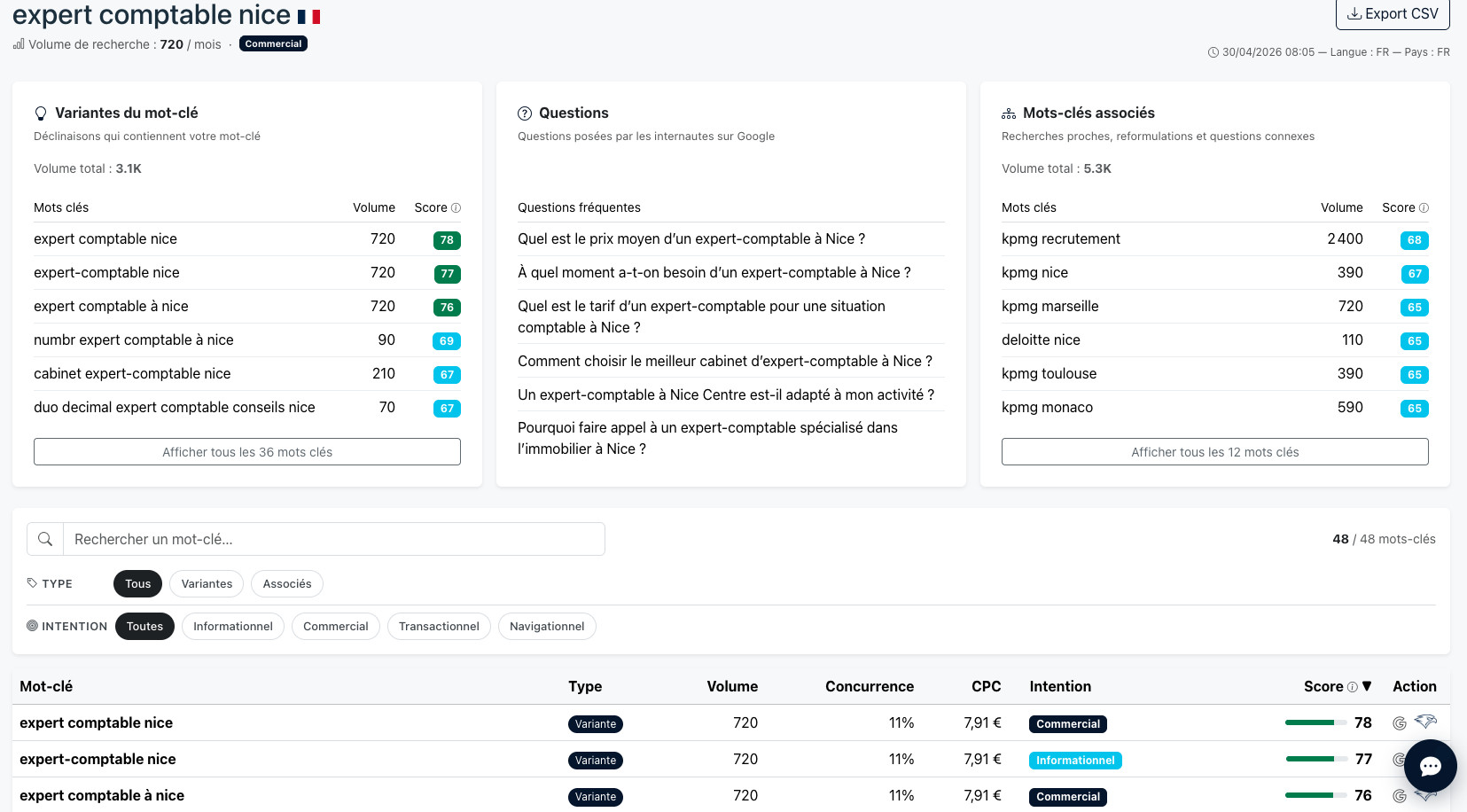
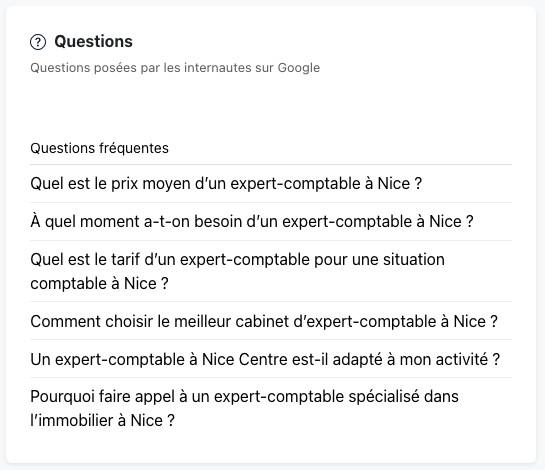
On top of the keywords, Horusium returns 6 questions real users actually ask about the topic. Very useful for structuring an article, writing a FAQ, or spotting the angles missing from Google's top 10.
Results are available in 5 to 15 seconds, exportable to CSV, with automatic filtering of off-topic keywords to keep a clean list from the very first glance.
SEO audit and site SEO Health
This is where Horusium clearly pulls ahead of Ubersuggest. The tool audits a page across 8 modules against its Google top 10 (score /100, prioritized action plan, before/after PDF report), and offers an SEO Health module connected to Google Search Console that detects: zombie pages, cannibalizations, query opportunities, rising/declining trends. No Ubersuggest plan offers this level of analysis on overall site health.
Limits worth acknowledging
- No large-scale daily rank tracking (Ubersuggest offers it in its Rank Tracker module).
- No large-scale backlink database for prospecting (referring domains are included in a page audit, but it's not a pure link-building tool).
- No multi-project management with separate dashboards (a Horusium account handles all your audits in a single filterable list).
2. Google Search Console — 100% free, your own data
Google Search Console isn't a keyword research tool in the strict sense, but it's the official source of your SEO data. There you see the queries your site appears on in Google, impressions, clicks, CTR, average position, and every indexed page. What GSC contains is your real Google data — not an estimate like in Ubersuggest.
The catch is that GSC only shows your own site (you can't spy on competitors) and it takes time to filter what deserves your attention. That's exactly the role of tools like Horusium SEO Health, which plug into GSC to turn that raw data into an action plan.
Best for: everyone. Install it first, it's free forever, and pair it with a more advanced analysis tool.
3. Ahrefs Webmaster Tools — Free pro backlinks
Ahrefs Webmaster Tools (AWT) is the free version of Ahrefs for site owners. You verify ownership of your domain, and you get for free: real Ahrefs backlink data (the deepest database on the market), Domain Rating, the top organic keywords you rank for, and a technical site audit (limited but serious).
The catch: AWT only works on the sites you own and verify. You can't spy on competitors' backlinks like in paid Ahrefs. But for your own SEO, it's strictly superior to Ubersuggest's free tier.
Best for: site owners who want top-tier free tools, alongside a keyword research tool.
4. Google Keyword Planner — Real Google volumes, free
Google Keyword Planner is Google's official tool for advertisers. It's the source that Ubersuggest and every other SEO tool try to estimate. You open a Google Ads account (without necessarily spending a cent), and you get keyword ideas, competition levels and volume ranges straight from Google.
The catch: without active ad spend, volumes come in very wide ranges (for example 1,000 – 10,000 instead of a precise figure). It's less readable than the enriched data from Horusium or Mangools. But reliability stays higher than Ubersuggest's, because the data comes straight from Google.
Best for: cross-checking volumes with another tool, confirming a keyword really exists, spotting related terms to explore.
5. Mangools — The best beginner UI
Mangools bundles 5 tools: KWFinder (keyword research), SERPChecker (SERP analysis), SERPWatcher (rank tracking), LinkMiner (backlinks) and SiteProfiler (audit). At $29/month, it's a slight premium over the $12 Ubersuggest plan, but the gap in data quality and UX is significant.
KWFinder is widely regarded as the most accessible keyword research tool for beginners: clean interface, 12-month trend curve, an understandable difficulty score, relevant suggestions. It's the opposite of Ubersuggest's cluttered UX.
Best for: beginners who want a clear interface, freelancers who need Mangools as their main tool and are fine with the monthly subscription.
6. SE Ranking — The agency step up
If you find Ubersuggest too lightweight and you need agency features (white-label reports, multi-client management, large-scale rank tracking), SE Ranking is the natural step up. Solid technical audit, deep keyword database, clean client reporting.
Pricing starts at $65/month (Essential plan), well above Ubersuggest but well below Semrush. It's a true Semrush-light that covers 80% of a small agency's needs.
Best for: small SEO agencies, consultants juggling several clients at once who need white-label reports.
7. Moz Free Tools — Domain Authority and a free quota
Moz's free tools include MozBar (browser extension), Link Explorer (10 free queries/month), Keyword Explorer (10 free queries/month) and Domain Authority lookups. The DA metric is a widely cited authority score you won't find natively in Ubersuggest.
For occasional competitive checks, Moz's free quota is enough. For daily research, you'll blow past it quickly — and Moz Pro starts at $99/month, well above Ubersuggest.
Best for: occasional checks, a Domain Authority check before a partnership or a link exchange.
How to replace Ubersuggest without losing features
Here are three practical stacks that replace Ubersuggest depending on your budget and usage level.
100% free stack (zero budget)
- Google Search Console (your own data);
- Ahrefs Webmaster Tools (backlinks + audit of your verified sites);
- Google Keyword Planner (raw volumes from Google);
- PageSpeed Insights (Core Web Vitals);
- + the free credit at Horusium signup for a first full audit.
This stack covers 90% of the use cases of an independent SEO or a site owner just starting out. No credit card, no commitment.
Pay-as-you-go stack (variable budget, irregular usage)
- Google Search Console (free);
- Horusium Essential pack €59 = 60 credits;
- = 60 SEO audits, or 12 audits + 240 keyword searches, or any mix.
You pay once, you get several months of autonomy, and you top up when your credits run out. Your total cost over a year depends on your real usage, whereas Ubersuggest bills you every month, even the months with no activity.
Subscription stack (intensive daily usage)
- Google Search Console (free);
- Mangools $29/month or SE Ranking $65/month for keyword research and rank tracking;
- + Horusium as a complement for serious audits and SEO Health.
If you're in an agency with daily usage, the monthly subscription becomes worth it. But that's exactly the profile Ubersuggest isn't built for — you'd move up-market anyway.
Which alternative to choose based on your profile?
You're a freelancer with irregular usage → Horusium
The months you don't invoice, you don't pay. The free credit and the 3 free searches at signup let you test with no commitment. When you start a project, you top up 60 credits for €59 and it lasts several months. It's the opposite logic to Ubersuggest, and it's the right answer for a freelancer.
You work in European languages (FR, EN, IT, DE, ES) → Horusium
Ubersuggest has a decent French interface but remains an American tool — the recommendations, examples and guides are designed for the US market. Horusium is built in France and offers a native linguistic analysis across 5 European languages (French, English, Italian, German, Spanish), with a dedicated analysis engine per language. In French, that means elisions (d'humidité, l'audit), morphological variants (accents, plurals) and semantic nuances are handled correctly, whereas no American tool goes down to that level of detail.
You want 100% free → GSC + AWT + Keyword Planner
The Google Search Console + Ahrefs Webmaster Tools + Google Keyword Planner combo covers most basic SEO needs without paying a cent. Limitations: no broad competitive spying, no semantic SERP analysis, no page-by-page audit against Google's top 10.
You want the best paid UI → Mangools
If you liked Ubersuggest for its all-in-one side but you want better data and a clean UI, Mangools at $29/month is the natural upgrade. KWFinder is a real upgrade over Ubersuggest's keyword tool.
You run a small agency → SE Ranking
If you need white-label reports, multi-client management and large-scale rank tracking, SE Ranking at $65/month is built for it. And it stays well below Semrush's pricing.
FAQ — common questions about Ubersuggest alternatives
Is there a real free alternative to Ubersuggest?
Yes: Google Search Console is free forever for your sites. Ahrefs Webmaster Tools is free forever for site owners (with real Ahrefs backlink data). Google Keyword Planner is free with a Google Ads account. Stacking these three tools covers a large part of real SEO needs, without paying anything. On top of that, Horusium offers 1 credit + 3 keyword searches at signup, with no credit card.
What's the cheapest paid alternative to Ubersuggest?
On paper, Ubersuggest itself ($12/month) is still the cheapest credible SEO tool on a subscription. But compared to Horusium in terms of total annual cost for irregular usage: $12 × 12 = $144/year with Ubersuggest (whether you use it or not), versus €59 once for 60 Horusium credits with no expiration. Over 2 to 3 years of normal usage, Horusium comes out significantly cheaper.
Can Horusium really replace Ubersuggest?
For keyword research, yes: Horusium returns up to 200 enriched keywords (volume, CPC, competition, intent, score) + 6 Google questions per search, with automatic filtering of off-topic keywords to keep a directly usable list. On top of that, you get the SEO audit of a page across 8 modules and the site's SEO Health (cannibalizations, zombie pages) — two modules Ubersuggest doesn't have. The only feature Horusium doesn't cover that Ubersuggest offers is large-scale daily rank tracking. If that's your number one need, complement it with Mangools SERPWatcher.
Is Google Search Console enough on its own?
For a single small site, yes — for a while. GSC gives real Google data on your site but no competitive insight, no keyword database beyond your own queries and no comparative analysis against Google's top 10. To write an article that ranks against the competition, or to spot cannibalization between pages, you need an analysis layer on top. That's the role of tools like Horusium.
How good is Ubersuggest's free 3 searches/day offer?
For pure testing, fine. But 3 searches per day disappear in 5 minutes as soon as you do real research (a single topic usually needs 10 to 20 searches to map out keywords, sub-topics and questions). Horusium's 3 free searches at signup, by contrast, let you run a serious session across 3 different topics, with no daily cap.
Conclusion: the best alternative depends on your usage
If we had to keep one idea: Ubersuggest's low price is paid for in data quality, a cluttered UX and a subscription model that doesn't line up with intermittent SEO usage. For 90% of the real cases of a French freelancer or consultant, the combination Google Search Console + Horusium on credits covers the same needs with far better data quality, no monthly commitment, and with extra tools Ubersuggest doesn't have (site SEO Health, optimized article writing, enriched keyword research with real user questions).
To get started, create an account on Horusium (free credit + 3 free keyword searches, no credit card), connect your Google Search Console to the SEO Health module, and run a keyword search on one of your topics. In 5 minutes, you'll have a direct comparison with the Ubersuggest experience — and you'll know whether the switch is worth it for your usage.