Ahrefs is one of the historic references in SEO, famous for the depth of its backlink index and the richness of its keyword data. It's a formidable tool — but when you actually put it in the hands of a freelancer, a consultant or a small team, three limits come up again and again: a high entry price (the full plans run into hundreds of euros a month), a dense interface built for experts who already know what to look for, and an exploration-first scope (backlinks, rankings, volumes) that tells you where you stand without really telling you what to write to outrank your competitors.
This article is published on the Horusium blog, so we won't hide behind fake neutrality: yes, Horusium is one of the alternatives I present, and it's even the one we stand behind. But for the comparison to be worth anything, I've included the 6 other serious tools on the market — affordable, all-in-one or free — with their real strengths and limits. The goal isn't to make you pick Horusium just because you're reading this: it's to give you what you need to choose the tool that fits your usage, and to explain why Horusium is our answer for those who find Ahrefs too expensive, too complex, or too far from getting things done.
Why look for an Ahrefs alternative?
Ahrefs is an excellent tool. Looking for an alternative doesn't mean it's bad — it means it may not fit your budget, your level or your real need. Three complaints keep coming up from users who move to something else:
- The entry price: genuinely usable plans start at around $129/month, with credit limits that climb fast once you work seriously. For irregular usage, you pay a full monthly subscription even in the months you don't touch the tool.
- The complexity: Ahrefs displays hundreds of metrics with no obvious hierarchy. It's a strength for an expert who knows what to look at, a wall for a beginner or for anyone who just wants to know "what should I change on this page?".
- The scope: Ahrefs excels at backlinks, keyword exploration and rank tracking. But it doesn't tell you concretely what the Google top 10 pages do that you don't, and it doesn't write the content for you. The "from data to action" step is on you.
A good Ahrefs alternative should fix at least one of these three points: a pricing model aligned with your real usage, an easier learning curve, or an "action-first" orientation (knowing what to write, not just where you stand).
Comparison table of the 7 Ahrefs alternatives
| Tool | Model / price | Keyword research | SEO audit | Backlinks | Best for |
|---|---|---|---|---|---|
| Horusium | Credits, no subscription (from €59 for 60 credits) | Yes (up to 200 KW + 6 questions) | Yes (page vs top 10 + site SEO health) | Partial (within the audit) | Freelancers, EU consultants, irregular usage |
| Semrush | Subscription, from ~$140/month | Very complete | Yes (Site Audit) | Very complete | Agencies, intensive daily usage |
| SE Ranking | Subscription, from ~$65/month | Yes | Yes (audit + rank tracking) | Yes | Small agencies, pro freelancers |
| Mangools | Subscription, from ~$29/month | Yes (KWFinder) | Yes (SiteProfiler) | Yes (LinkMiner) | Beginners, tight budgets |
| Moz Pro | Subscription, from ~$99/month | Yes | Yes | Yes (Domain Authority) | Authority tracking, reporting |
| Ubersuggest | Subscription from ~$12/month (or lifetime license) | Yes (estimated data) | Partial | Partial | Entry level, small sites |
| Free Google + AWT stack | Free for life | Your real data + raw volumes | Partial | Yes (Ahrefs Webmaster Tools) | Zero budget, site owners |
Prices are indicative: each vendor regularly adjusts its plans, credit tiers and promotions. Always check the current pricing before deciding.
1. Horusium — The pay-as-you-go alternative
Horusium is a French SEO platform designed for freelancers, consultants and small teams who want a complete tool without a monthly subscription. It's the most direct answer to the two main complaints about Ahrefs: the entry price and the complexity. You pay for what you use, and the tool is built around a single question: what do I need to change to outrank the Google top 10?
The business model: credits that never expire
You buy credits, and each action consumes some:
- 1 credit = 1 full SEO audit (of a page or the site's SEO health);
- 1 credit = 1 written and optimized article (SEO or GEO);
- 1 credit = 5 keyword searches.
Credits never expire. You can buy 60 credits for €59 (~€0.98 per credit) and use them over 3 months or 18 months, it makes no difference. When you sign up, you get a free credit plus 3 keyword searches — enough to test a full audit or a serious search, without entering a card.
Compared to Ahrefs, whose full plans start at around $129/month (over $1,500/year, whether you use it or not), it's a radical change of logic: you pay for your real usage, not a theoretical plan renewed every month.
What Horusium does that Ahrefs doesn't: tell you what to write
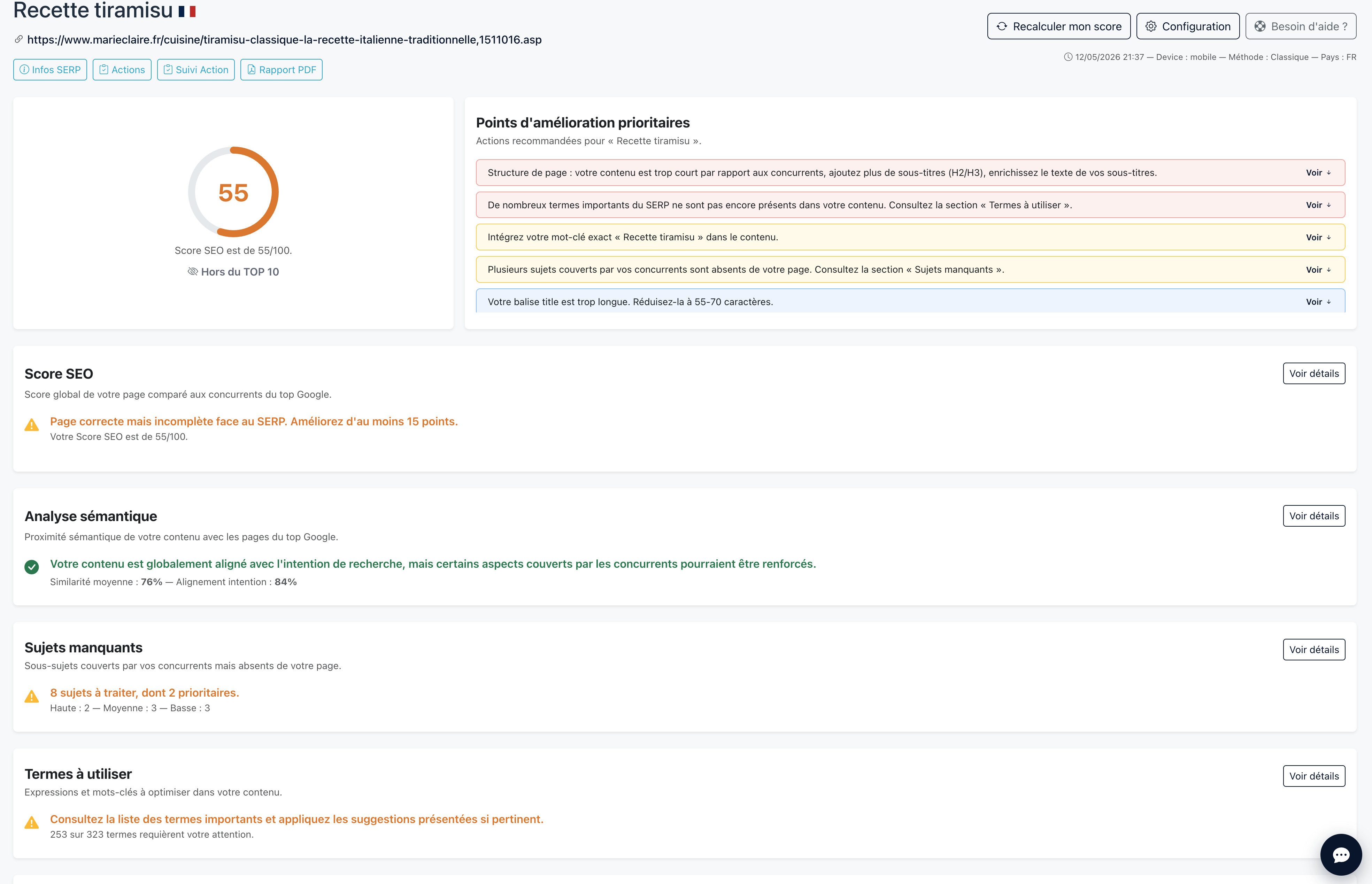
This is the real difference in philosophy. Ahrefs gives you metrics; Horusium gives you a method. For a given keyword, Horusium's SEO audit compares your page to the ones ranking in the Google top 10 and returns:
- An SEO score out of 100, an objective quantified diagnosis across 8 concrete modules;
- A prioritized action plan (changes sorted by recoverable points);
- The missing terms and topics your competitors cover and you don't;
- Internal linking suggestions with optimized anchors;
- A before/after PDF report to justify the work to a client.
Horusium also adds what Ahrefs doesn't have: the writing of optimized articles (classic SEO and GEO, built to rank in AI answers) and a SEO Health module connected to Google Search Console that detects zombie pages, cannibalization and query opportunities across the whole site.
Keyword research: Ahrefs' home turf
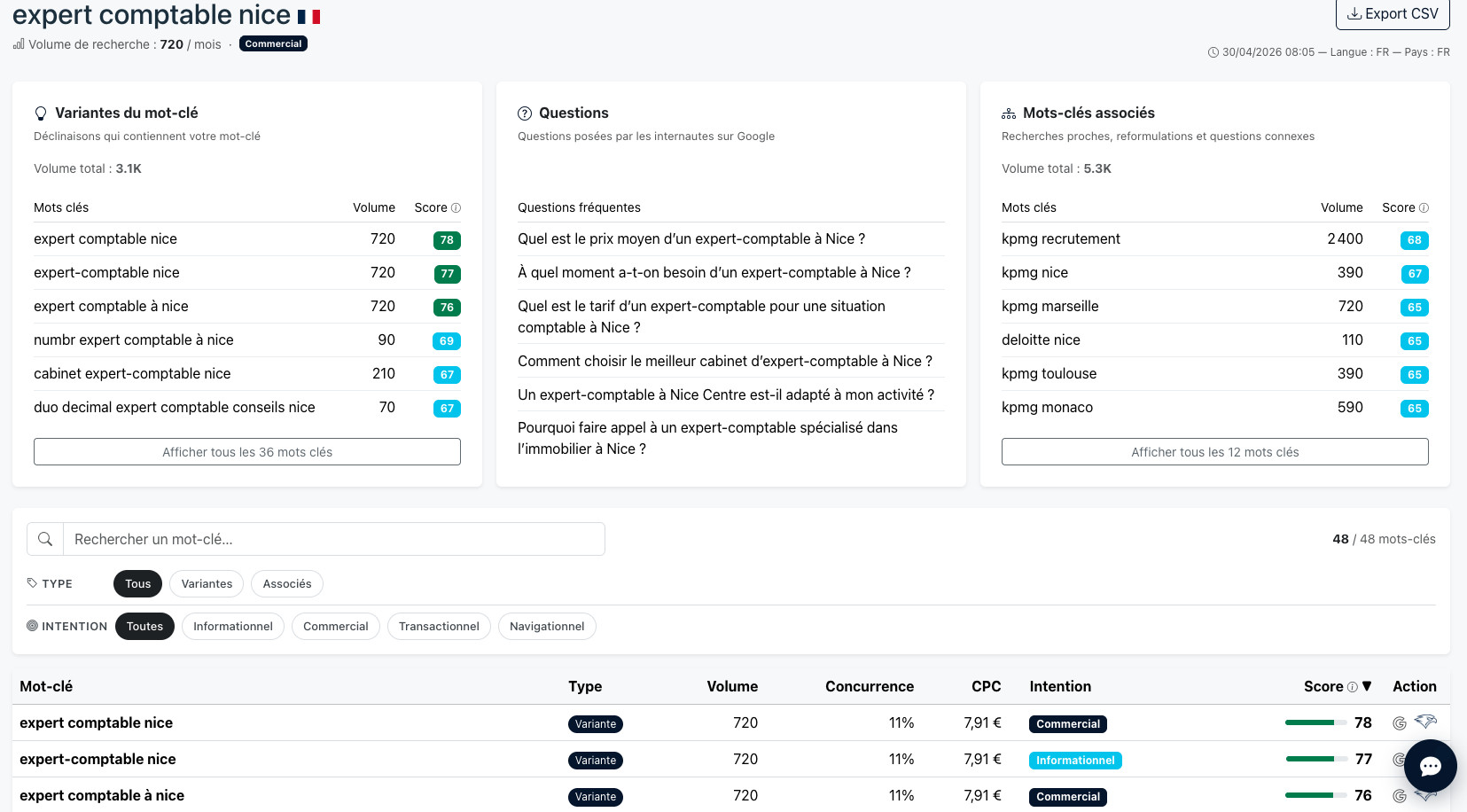
This is historically one of Ahrefs' strong points. Horusium doesn't play in the same league on raw data volume, but its keyword research covers the essentials of the real need: for each keyword you enter (with a choice of language and country), it returns up to 200 enriched keywords with their metrics:
- Monthly search volume;
- Competition (0-1);
- Average CPC;
- Search intent (informational, commercial, transactional, navigational);
- Horusium score /100 (volume + competition + relevance);
- Type (variant or related keyword).
On top of that, each search returns 6 questions people actually ask about the topic — perfect for structuring an article, a FAQ, or spotting the angles the top 10 overlooks.
Limits to acknowledge
- No large-scale backlink database for prospecting: this is the heart of Ahrefs, and Horusium doesn't try to replace it here (referring domains are included in a page's audit, but it's not a pure link-building tool).
- No large-scale daily rank tracking across thousands of keywords.
- No "content explorer" or competitor organic-traffic analysis at Ahrefs' level of detail.
2. Semrush — The direct all-in-one competitor
If you're looking for an Ahrefs alternative with the same scope (backlinks, keywords, rank tracking, technical audit, competitive intelligence), Semrush is the most obvious rival. The database is huge, the toolset is vast, and many agencies switch between the two depending on the client.
The catch: you don't really escape the price or the complexity. Semrush starts around $140/month and packs a feature density that can drown an occasional user. It's a change of vendor, not a change of logic.
Best for: agencies and intensive SEOs who want an Ahrefs-equivalent platform but prefer the Semrush ecosystem.
3. SE Ranking — The affordable agency alternative
SE Ranking covers the essentials of Ahrefs (keyword research, rank tracking, technical audit, backlink analysis) at a fraction of the price, with white-label reports agencies love. It's a genuine "Ahrefs-light" that covers 80% of a small operation's needs.
Pricing starts at around $65/month, well below Ahrefs and Semrush. The trade-off: a backlink index and data depth below the two giants.
Best for: small agencies and consultants managing several clients who need white-label reporting without the Ahrefs budget.
4. Mangools — The best value for beginners
Mangools bundles 5 tools: KWFinder (keywords), SERPChecker (SERP analysis), SERPWatcher (rankings), LinkMiner (backlinks) and SiteProfiler (audit). From ~$29/month, it's one of the most accessible alternatives, with an interface praised for its clarity — the opposite of Ahrefs' density.
The catch: the backlink index and data volumes stay far from Ahrefs. For large-scale link prospecting or deep competitive intelligence, you'll feel the difference.
Best for: beginners and tight budgets who want a clean UI and the essentials of Ahrefs' features.
5. Moz Pro — Domain authority and the link index
Moz Pro is one of the SEO veterans. Its differentiator is still Domain Authority (DA), a widely cited authority score, paired with a decent link index, rank tracking and a site audit. Reporting is polished.
Pricing starts at around $99/month. The backlink index depth stays behind Ahrefs, but if your workflow revolves around DA and authority comparison, Moz remains relevant.
Best for: those who steer their SEO by domain authority and want clean reporting.
6. Ubersuggest — The entry level
If your main goal is simply to cut the bill, Ubersuggest is one of the cheapest credible SEO tools, with a subscription from ~$12/month and even a lifetime license option. It covers keyword research, a basic site audit and a backlink overview.
The catch: the data is estimated and sometimes diverges from real figures, the backlink index is smaller than Ahrefs', and the interface pushes a lot of upsells. It's an entry-level tool, not a full Ahrefs replacement. We've dedicated a full comparison to it: see our article on Ubersuggest alternatives.
Best for: small sites and very tight budgets that accept approximate data.
7. The free stack: Google Search Console + Ahrefs Webmaster Tools
Before paying anything, know that you can cover a large part of your SEO needs with free tools:
- Google Search Console: your real Google data (queries, impressions, clicks, positions, indexing). It's the official source, not an estimate. Free for life.
- Ahrefs Webmaster Tools (AWT): the free version of Ahrefs for sites you own and verify. You get real Ahrefs backlink data, Domain Rating and a technical audit — a great way to taste Ahrefs' depth for free.
- Google Keyword Planner: raw keyword volumes straight from Google (in ranges), free with a Google Ads account.
The limit: no broad competitive spying, no page-by-page comparison against the top 10, and AWT only works on your own sites. This stack pairs very well with Horusium's free sign-up credit for a first comparative audit.
Best for: zero budget and site owners who want premium free tools.
How to replace Ahrefs depending on your need
Three practical stacks depending on your budget and usage intensity.
100% free stack (zero budget)
- Google Search Console (your own data);
- Ahrefs Webmaster Tools (backlinks + audit of your verified sites);
- Google Keyword Planner (raw volumes from Google);
- + Horusium's free sign-up credit for a first full comparative audit.
Pay-as-you-go stack (irregular usage)
- Google Search Console (free);
- Horusium Essential pack €59 = 60 credits that never expire;
- = 60 audits, or 12 audits + 240 keyword searches, or any mix.
You pay once, you're covered for several months, and you top up when your credits run out. Over a year of irregular usage, the total cost is nothing like an Ahrefs subscription renewed every month.
Intensive stack (daily usage, agency)
- Semrush or SE Ranking for exploration, backlinks and large-scale rank tracking;
- + Horusium as a complement for comparative audits, SEO Health and writing optimized articles.
If you're an agency with daily usage, a full subscription makes sense: you just have to pick which one based on your preferred ecosystem, and graft Horusium on for the "action" and writing side.
Which alternative should you choose for your profile?
You have irregular usage → Horusium
The months you don't bill, you don't pay. The free credit and the 3 free searches at sign-up let you test without commitment. It's the opposite logic of an Ahrefs subscription, and the right answer for a freelancer.
You mainly want to know what to write to rank → Horusium
If your need isn't "explore data" but "understand what separates my page from the top 10 and fix it", Horusium is built exactly for that: score /100, prioritized action plan, missing terms and topics, then assisted writing. Ahrefs would give you the raw material; Horusium gives you the steps to follow.
You work in European languages (FR, EN, IT, DE, ES) → Horusium
Ahrefs is an international tool whose recommendations and interface are built first for English speakers. Horusium is designed in France and offers native linguistic analysis in 5 European languages (French, English, Italian, German, Spanish), with a dedicated analysis engine per language — a level of detail an English-first tool rarely reaches.
You want the same scope as Ahrefs → Semrush or SE Ranking
To get massive backlinks, large-scale rank tracking and competitive intelligence, Semrush (premium equivalent) or SE Ranking (affordable equivalent) are the closest replacements, feature for feature.
You want the smallest budget → Mangools, Ubersuggest or the free stack
Mangools for the best affordable UI, Ubersuggest for the absolute entry level, or the free combo Google Search Console + Ahrefs Webmaster Tools + Keyword Planner if you accept its limits.
FAQ — common questions about Ahrefs alternatives
Is there a free alternative to Ahrefs?
Partly, yes. Ahrefs Webmaster Tools is the free version of Ahrefs for sites you own (real backlink data, Domain Rating, technical audit). Paired with Google Search Console and Google Keyword Planner, you cover a good part of your needs for free. Horusium adds a free sign-up credit + 3 keyword searches, no card required.
What is the cheapest Ahrefs alternative?
In pure subscription terms, Ubersuggest (~$12/month) and Mangools (~$29/month) are the most affordable. But for irregular usage, Horusium on credits often works out cheaper over the year: you pay once (€59 for 60 credits that never expire) instead of a subscription renewed every month even without activity.
Can Horusium really replace Ahrefs?
It depends on your usage. To audit a page and know what to fix to outrank the top 10, run enriched keyword research and write optimized articles, yes: that's the very core of Horusium, and it goes further than Ahrefs on getting things done. On the other hand, for a massive backlink database and very large-scale rank tracking, Ahrefs remains superior — that's its historic turf, which Horusium doesn't try to replace.
Ahrefs or Semrush as a full alternative?
Both are comparable on scope: huge databases, backlinks, keywords, rank tracking, audit. The choice often comes down to ecosystem and habit. But neither solves the price problem for occasional usage: for that, a pay-as-you-go model like Horusium is structurally better suited.
Why is Ahrefs so expensive?
Ahrefs maintains one of the largest backlink indexes on the web, which requires a colossal crawling infrastructure. That cost flows into the price. If you don't exploit that data depth daily, you're paying for capacity you don't use — hence the appeal of an alternative aligned with your real usage.
Conclusion: the best alternative depends on your usage
If we had to keep one idea: Ahrefs is a premium exploration tool, cut out for intensive usage and for experts who exploit its data depth. If that's not your case — irregular usage, a measured budget, a need to move fast "from data to action" — you're paying a lot for power you don't use.
For most freelancers and consultants, the combination Google Search Console + Horusium on credits covers the real needs with a much better budget fit, no monthly commitment, and with tools Ahrefs doesn't have: comparative audit against the top 10 with an action plan, site SEO health, and writing optimized articles. For large-scale link prospecting, keep Ahrefs (or its free AWT version) as a complement.
To get started, create a Horusium account (free credit + 3 free keyword searches, no card) and run a first audit on one of your pages. In a few minutes, you'll know whether the "action-first" approach suits you better than the metrics factory.