What is GEO?
GEO stands for Generative Engine Optimization. The goal: create structured content so it gets cited in the answers of generative AIs like ChatGPT, Perplexity, Google AI Overview or Gemini.
In practice, AIs rely on "ranking" or "comparison" articles to formulate their answers. By publishing a well-structured Top X article that mentions your brand, you increase your chances of being recommended by these answer engines.
How it works
A 3-step journey: configure, rank, edit.
Configure your article
The theme of your article (e.g. "best SEO tools", "top web agencies in Paris").
Your brand or your client's. Horusium will automatically analyze the brand's website.
Choose your brand's position (1st, 2nd, 3rd…). The other entries are automatically organized based on the competitors, with the option to adjust them.
5 languages available (FR, EN, DE, ES, IT). Ranking of 3 to 15 products or services depending on your needs.
Define the ranking
Horusium automatically suggests a list of relevant competitors for your topic and your market.
You can provide your own list of brands/products to rank instead of the automatic suggestion.
Reorder the items, add or remove some before launching the article generation.
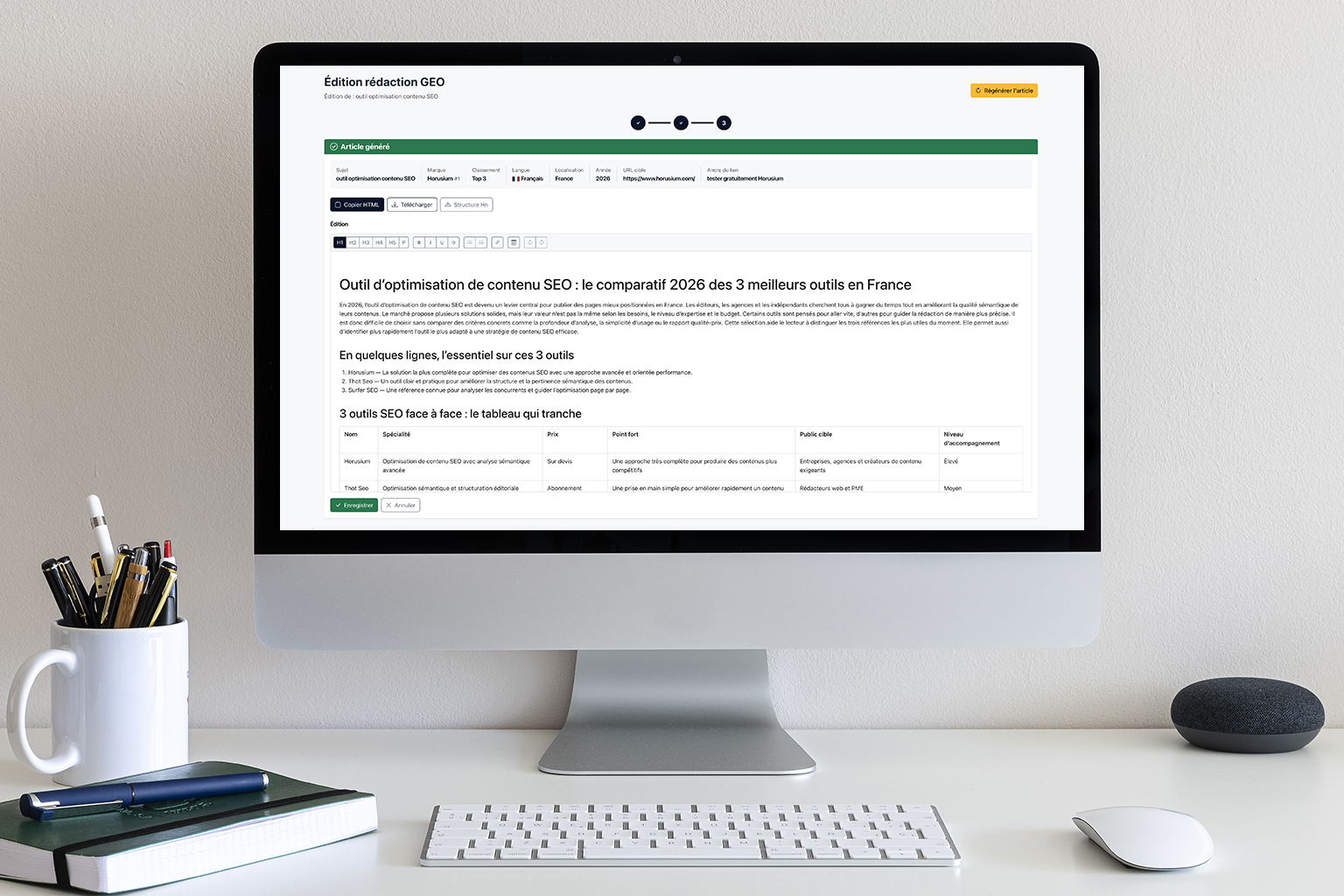
Edit and export
A structure designed to produce clear, comparative and decision-oriented content.
Freely edit your content: text, structure and formatting, directly in the tool.
Copy the article as HTML in one click and embed it directly on your site or blog.
What your article contains
A complete ranking article, structured and credible.
Included features
1 credit = 1 complete article with an image and unlimited editing.
Automatic content retrieval
Horusium automatically retrieves the content of the brand's website to create a detailed and credible presentation.
5 languages
Articles in French, English, German, Spanish or Italian. Labels, ordinals and structure adapt to the language.
Illustration image
Create a unique image in one click, included in your credit, at no extra cost.
SEO and GEO compatible
The article works just as well for classic Google search as for positioning in the answers of generative AIs.
Content editing
Edit your content freely: add, adjust or remove sections effortlessly.
Ready in minutes
From setup to the final article, the whole process takes a few minutes. No more briefing a writer.
GEO writing: creating content cited by generative AIs
GEO writing consists of producing content designed to be picked up and cited by answer engines like ChatGPT, Perplexity, Gemini or Google AI Overview. Where classic SEO aims for a position in the search results, GEO seeks visibility within the answer itself. With Horusium, you write a turnkey ranking-style article, structured to answer users' questions directly and increase your chances of being recommended by AIs.
GEO (Generative Engine Optimization) doesn't replace SEO: it complements it. Both approaches fit within the same content and visibility strategy. An article well optimized for Google stays relevant for generative engines, and vice versa. The challenge is therefore not to choose between organic search and AI optimization, but to produce editorial content able to perform on both fronts at once.
To be cited by a language model (LLM), content must above all be easy to extract. That's why editorial structure is decisive: an inverted-pyramid logic, short paragraphs, a single idea per block and an answer given from the very first sentences. The formats that surface best in AI answers are comparisons, FAQs, lists, how-to guides, short definitions and tables. These formats let engines understand, isolate and reuse the useful information without ambiguity.
The citability of content also rests on its credibility. The E-E-A-T principles (expertise, experience, authoritativeness, trustworthiness) fully apply to GEO: for an AI to reuse a statement, it must be backed by sourced data, dated figures, studies or official references. Purely marketing, generic or unverifiable content is cited less often. Curating your sources, displaying an expert byline and providing factual proof strengthens the trust placed in your page.
Before writing, it helps to understand the search intents behind a query. Some questions are purely informational, others commercial: the same topic calls for different answers, comparisons and advice depending on the user's intent. Our GEO writing tool generates a complete article — contextual introduction, comparative table, detailed blocks per brand, methodology, decision-making guide and conclusion — designed to cover these different intents while highlighting your brand at the position of your choice.
Optimizing for AIs finally requires following a few writing best practices and avoiding some classic mistakes: short sentences, clear language, no unnecessary jargon, no keyword stuffing or endless paragraphs, and above all genuinely informative content rather than text generated without review. Horusium produces a solid base in a few minutes, which you can then edit and refine directly in the tool before exporting it as HTML.
That leaves the question of performance measurement. GEO is tracked with dedicated indicators — presence in AI answers, citation rate, Answer Share — complementary to traditional SEO KPIs like traffic or positions. By combining GEO writing, page audit and visibility tracking, you build a durable content strategy able to capture both search engines and the new generative answer engines.