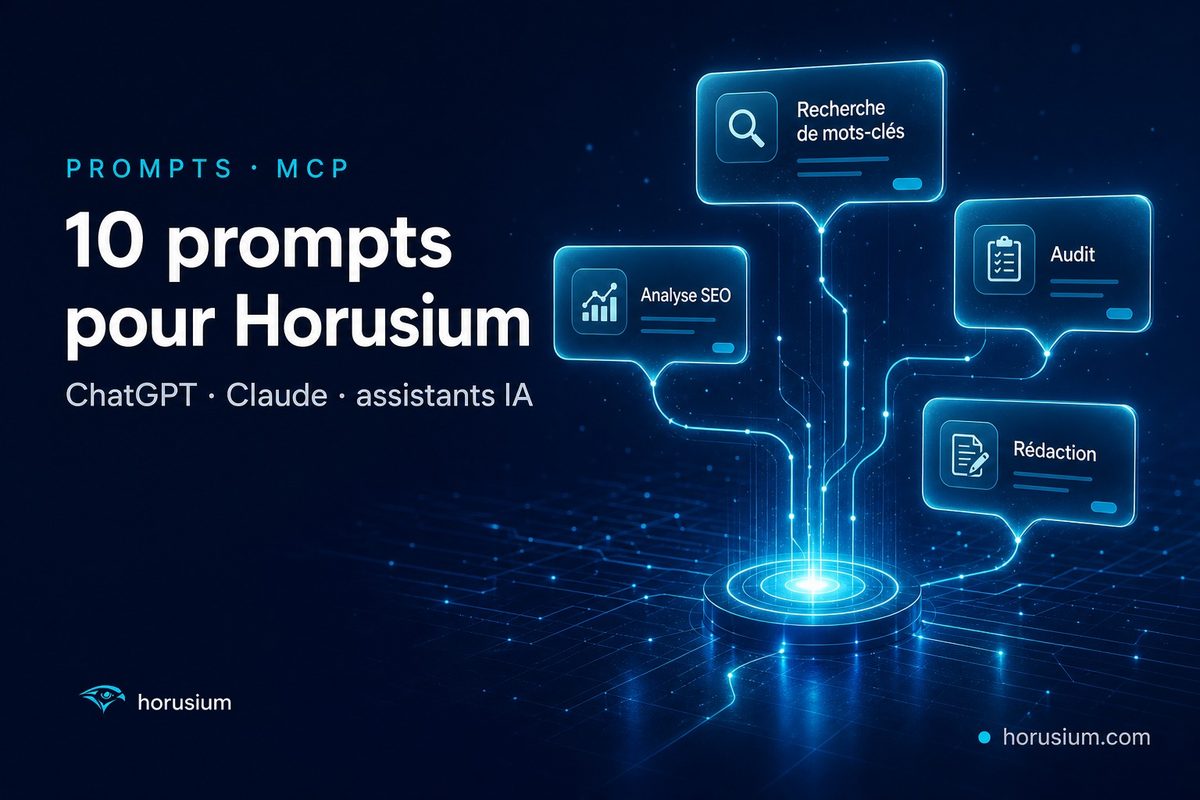
With the Horusium MCP, you're not limited to a single isolated command. You can simply give your AI assistant — ChatGPT, Claude or any compatible assistant — an SEO goal and ask it to use the various Horusium tools to reach it.
Keyword research, intent analysis, SEO audit, competitor study, missing-topic detection, SEO writing or GEO content creation can all be combined within a single conversation. The assistant can also analyze the results Horusium returns, cross them and help you turn that data into concrete actions.
Here are 10 ready-to-use workflows, followed by a set of quick prompts. Copy a prompt, replace the few variables in brackets, and paste it into your assistant.
Complete SEO workflows
1. Fully optimize an existing page
The workflow that best captures the value of the Horusium MCP: from a single request, the assistant combines keyword research, SEO audit, competitor analysis and writing, then proposes an optimized page.
Keyword research → Intent analysis → SEO audit → Competitor analysis → Missing topics → SEO writing → Editorial review → Final recommendations
I want to improve the SEO of the page [URL] around the keyword "[KEYWORD]".

Use Horusium to run a complete SEO workflow:

1. Run a keyword research based on "[KEYWORD]".
2. Analyze the results and identify the keywords and search intents most relevant to my page.
3. Then run an SEO audit of [URL] on the main keyword.
4. Analyze the audit and cross-reference its recommendations with the previous keyword research.
5. Identify missing topics, semantic opportunities and priority improvements.
6. Run a Horusium SEO writing on the main keyword.
7. Analyze the generated content and use it as a basis to propose an optimized version of my page.

Do not mechanically follow keyword frequency recommendations: always favor natural wording adapted to the language.

At the end, tell me what you would change on my page first and why.
2. Audit a page and identify the 5 priority actions
Quickly get the SEO optimizations that should have the most impact on an existing page.
Analyze this page with Horusium:

[URL]

I want to rank for "[KEYWORD]".

Run an SEO audit, analyze competitors, missing topics and semantic recommendations.

Then give me the 5 changes that would, in your view, have the most SEO impact.

For each recommendation, explain:

- what the problem is;
- why it may limit rankings;
- what you would change concretely;
- the priority: high, medium or low.

Don't just rely on the Horusium score: interpret the recommendations and discard those that seem artificial or irrelevant.
3. Build an SEO strategy from keyword research
Turn a Horusium keyword research into a real SEO content plan.
Use Horusium to research keywords around "[KEYWORD]".

Analyze the results and group the keywords by search intent.

Then build an SEO strategy by identifying:

- the main keyword;
- the secondary keywords;
- the commercial pages to create;
- the blog articles to write;
- the keywords that can be grouped on a single page;
- any cannibalization risks.

Prioritize the opportunities based on:

- search volume;
- SEO difficulty;
- search intent;
- business relevance.

For each recommended page or article, also propose:

- a main keyword;
- an H1;
- the targeted search intent.
4. Create a new e-commerce category page
Build an e-commerce category from SEO data and the analysis of Google results.
I want to create a new SEO-optimized category page around the keyword "[KEYWORD]".

Use Horusium to build the page from SEO data:

1. Run a keyword research around "[KEYWORD]".
2. Analyze the results and group the keywords by intent.
3. Identify those this category should target and those that would deserve another page.
4. Identify the main keyword and the secondary expressions truly relevant for an e-commerce page.
5. Run a Horusium SEO writing on the main keyword.
6. Analyze and rework the generated content to remove artificial wording, excessive repetition and passages too close to a blog article.
7. Build me the final version adapted to an e-commerce category.

I want:

- a short introduction to place above the products;
- a more developed SEO content to place below the products;
- a relevant H2/H3 structure;
- an FAQ only if it adds real value;
- an SEO Title;
- a Meta Description.

The content must answer the search intent while staying commercial and natural.

Never force an expression just to hit a frequency recommended by the semantic analysis.

At the end, also tell me the topics or keywords discovered that would deserve their own page or article.
5. Create a new SEO article
Start from a topic and let Horusium identify search opportunities and the best angle before producing the article.
I want to write a new SEO article around the topic "[TOPIC]".

Use Horusium to build the article from the analysis of the demand and Google results:

1. Run a keyword research around "[TOPIC]".
2. Analyze the keywords, their volumes, their intents and the questions searched by users.
3. Group the queries by theme.
4. Determine those a single article can answer without mixing several different intents.
5. Determine the best editorial angle and the main keyword of the article.
6. Run a Horusium SEO writing on that keyword.
7. Then analyze the generated content and improve it to obtain a natural, pleasant and genuinely useful article.

Avoid keyword stuffing and do not artificially reproduce expressions from the semantic analysis when they are not natural.

In the end I want:

- an optimized but natural H1;
- an introduction;
- a complete H2/H3 structure;
- content answering the main identified intents;
- an FAQ based on the relevant questions discovered;
- an SEO Title;
- a Meta Description.

Also flag the keywords that should be the subject of other articles to build an editorial cluster around the topic.
6. Find 10 article ideas with SEO potential
Turn a general topic into an editorial calendar based on Horusium research data.
I want to grow my site's SEO traffic around the theme "[TOPIC]".

Run a Horusium keyword research around this topic.

Analyze the results, volumes, SEO difficulties, search intents and related questions.

Then propose 10 SEO article ideas.

For each idea, indicate:

- the proposed H1 title;
- the main keyword;
- the secondary keywords;
- the search intent;
- the available search volume;
- the available SEO difficulty;
- the value of this article in a content strategy.

Rank the articles by priority.

Avoid proposing several articles answering the same intent to limit cannibalization risks.
7. Build a complete SEO cluster
Create an editorial architecture around a topic with a pillar page, satellite content and an internal linking strategy.
I want to build an SEO cluster around the topic "[TOPIC]".

Use Horusium keyword research to analyze the semantic universe of the topic.

Group the queries by search intent.

Then build an architecture including:

- a main pillar page;
- the necessary secondary pages;
- the satellite articles;
- the main keyword of each piece of content;
- the secondary keywords;
- the recommended H1;
- the targeted intent.

Also explain how to organize internal linking:

- which articles should point to the pillar page;
- which contents should link to each other;
- which internal anchors can be used naturally.

Check that two different pages do not needlessly target the same search intent.

Finally, rank the contents in the order you recommend publishing them.
8. Turn an SEO audit into a brief for a writer
Turn a Horusium audit into simple, directly usable editorial instructions.
Run a Horusium audit of:

[URL]

on the keyword:

"[KEYWORD]"

Analyze the audit, competitors, missing topics and semantic recommendations.

Then turn the results into an editorial brief ready to hand to a writer.

The brief must contain:

- the page's objective;
- the search intent;
- the main keyword;
- the important secondary expressions;
- the essential topics to cover;
- the recommended H1/H2/H3 structure;
- the questions the content must answer;
- the existing elements to keep;
- the elements to improve or expand;
- any mistakes to avoid.

Do not impose grammatically artificial expressions on the writer just because they appear in the semantic recommendations.

Turn them into natural concepts or wording when necessary.
9. Understand what a page lacks compared to competitors
Identify the topics and information better covered by the competing pages in Google.
I want to understand what's missing on this page to better answer the query "[KEYWORD]":

[URL]

Run a Horusium audit.

Analyze mainly the topics covered by competitors but absent or insufficiently developed on my page.

Sort the gaps into three categories:

1. Essential to add.
2. Interesting to develop.
3. Of little use or optional.

For each important topic, explain:

- why competitors cover it;
- which user intent it helps address;
- how I could integrate it naturally into my page;
- whether it deserves a simple paragraph, a new section or a dedicated page.

Do not recommend adding content just to artificially increase the page length.
10. Generate and review a GEO / Top X comparison
Let Horusium build the ranking and write the article, then use your AI assistant for a final review pass.
I want to create a GEO / Top X comparison article on the topic "[TOPIC]".

Use Horusium GEO writing to generate a ranking of [NUMBER] solutions.

I want to highlight:

Brand: [BRAND]
Website: [URL]
Desired position: [POSITION]
Location: [LOCATION]
Year: [YEAR]

Let Horusium select the other players in the ranking.

Also request the SEO Title and the Meta Description.

Once the Horusium writing is done, proofread the article and check its consistency.

Flag in particular:

- claims that seem to need verification;
- potentially too assertive comparisons;
- artificial or overly promotional wording;
- any inconsistencies in the ranking.

Do not needlessly rewrite the article if the content generated by Horusium is already satisfactory.

At the end, give me the version ready to publish after any necessary corrections.
Quick prompts
You don't always need a complete workflow. Here are a few simple commands to use directly with your AI assistant.
Research keywords around "[KEYWORD]" with Horusium and show me the best opportunities, taking volume, difficulty and intent into account.Research keywords around "[KEYWORD]" with Horusium and find me the 10 opportunities with the best balance between search volume, SEO difficulty and business relevance.Audit [URL] on the keyword "[KEYWORD]" with Horusium and explain the main issues to fix in simple terms.
Audit [URL] on "[KEYWORD]" with Horusium and turn the result into an SEO checklist ordered by priority.
Show my last 5 Horusium audits and summarize their score and main recommendations.
Find my latest Horusium audit about [DOMAIN] and explain the priority actions.Run a Horusium SEO writing on "[KEYWORD]" with FAQ, Title and Meta Description.
Then proofread the result and only fix artificial SEO wording or excessive repetition.Research keywords around "[TOPIC]" with Horusium and propose 5 article ideas with interesting SEO potential.Audit [URL] on "[KEYWORD]" with Horusium and show me only the important topics covered by my competitors but missing from my page.
Audit [URL] on "[KEYWORD]" with Horusium and turn the recommendations into a simple brief to send to my writer.
Use Horusium to create a Top [NUMBER] on "[TOPIC]" placing [BRAND] in position [POSITION].

Brand website: [URL]

Let Horusium choose the other players in the ranking and also generate the Title and Meta Description.
Find my latest Horusium SEO writing on "[KEYWORD]".

Proofread it and tell me only what should be fixed before publishing: dubious information, repetition, artificial wording and readability issues.
The variables to customize
Simply replace the items in brackets with your own values:
- [URL] — URL of the page, site or brand
- [KEYWORD] — main SEO query
- [TOPIC] — general theme to study
- [DOMAIN] — domain concerned
- [BRAND] — brand to highlight in GEO content
- [NUMBER] — number of items in the ranking
- [POSITION] — desired position of the brand
- [LOCATION] — targeted geographic area
- [YEAR] — year of the comparison
The key takeaway: the Horusium MCP is not just about running isolated commands. Its real value is to let your AI assistant fetch SEO data, trigger analyses, launch writing tasks, cross several results and turn everything into concrete actions. Give your goal, let it use Horusium.