When you go looking for a serious SEO tool, two worlds quickly collide: on one side the historic all-in-one platforms like Semrush, which cover the whole of digital marketing (SEO, PPC, social, content, online reputation, and more), and on the other more specialized tools that focus on one part of the job but go deep. Horusium clearly belongs to the second camp: no PPC, no social, but a sharp focus on page-level SEO audits, optimized writing, keyword research and the SEO health of existing sites — all in a pay-as-you-go model.
This article is not a sales pitch. Semrush remains a benchmark tool, with a database no one matches in its segment. The point here is to lay out the real strengths of each, the limits of each, and to help you choose based on your profile (solo, agency, all-round marketer or content SEO).
Semrush in three lines: what it is, what it's worth
Semrush is a US platform founded in 2008, active on every front of digital marketing. Its promise: do everything in one place. The database is one of the broadest on the market — over 25 billion keywords indexed, more than 43 trillion backlinks, and tens of billions of pages crawled. On the feature side, you get: keyword research (Keyword Magic Tool), technical site audits (Site Audit, 140+ checks), backlink analysis, rank tracking, competitive research, Google Ads campaign management, content marketing tools, social media, and even online reputation management.
In practice, it's an extremely complete suite. If you handle SEO, paid, social and content all at once for several clients, Semrush ticks almost every box.
The real downsides:
- The price: $139.95/month for the Pro plan, $249.95 for Guru, $499.95 for Business. In euros and over a year, that adds up to a hefty budget (€1,500 to €5,500/year), whether you use the tool two hours a month or eight hours a day.
- The subscription: you pay every month, even in months when you have no active project. No way to pause without cancelling everything.
- The learning curve: the interface is dense, in English, and many users only ever tap into 10 to 20% of the features they pay for.
- The scope of content SEO: the SEO Writing Assistant is decent, but less advanced than a dedicated tool for fine-grained on-page optimization.
Horusium in three lines: what it is, what it's worth
Horusium is a French platform specialized in content SEO and the SEO health of websites. The scope is deliberately narrow, but explored in depth:
- SEO audit of a page (0-100 score across 8 modules + a prioritized action plan);
- SEO writing of articles optimized from SERP analysis;
- GEO writing for “ranking” style articles that push a brand into generative engines;
- Keyword research with rich data (volume, competition, CPC, intent, the questions people actually ask, Horusium score /100);
- Site SEO health via Google Search Console (zombie pages, cannibalization, query opportunities, trends);
- SEO action tracking (free) to document every optimization and visualize its impact on your Google Search Console curves.
The business model is very different from Semrush: no subscription, you buy credits that never expire. 1 credit = 1 audit, 1 credit = 1 piece of writing, 1 credit = 5 keyword searches. When you sign up, you get a free credit (an audit or a piece of writing, your choice) and 3 keyword searches — enough to really test the product before paying anything.
What Horusium does not do, and we own it:
- No Google Ads / PPC campaign management.
- No social media management.
- No large-scale backlink database for link-building prospecting (Horusium includes referring domains in its audit, but doesn't claim to replace a dedicated platform).
- No online reputation, no local reputation management.
Feature-by-feature comparison
Let's get concrete. Here are the main use cases of a modern SEO tool, and how each platform stacks up on them.
Keyword research
This is the historic domain of Semrush, and the database is unrivaled (25 billion+ keywords). You get volume, SEO difficulty, CPC, search intent, related keywords, trends, competitive gaps — in short, the full arsenal for strategy work.
Horusium offers a younger but already very complete module: for each keyword you enter, the tool returns up to 200 enriched suggestions (volume, CPC, competition, intent, Horusium score /100 blending volume, competition and semantic relevance), along with a list of 6 questions people actually ask about the topic — usable as they are in a FAQ or as article angles. CSV export is available.
Verdict: Semrush wins on database depth and broad competitive analysis. Horusium is more than enough for 90% of content SEO projects, and directly includes the questions people ask (handy for structuring an article or writing a FAQ).
SEO audit of a page
Semrush offers two distinct things: the Site Audit (a full technical site audit, focused on crawlability / indexability / speed / structure), and the On Page SEO Checker, which is more content-oriented.
Horusium takes the opposite angle: you audit a single page against its Google top 10, and get a score /100 computed across 8 modules (semantics, terms to use, internal linking, exact keywords, page structure, title/meta length, speed, indexability). The report is readable in under 5 minutes, with an action plan prioritized by recoverable points, and a before/after PDF report to make progress tangible for a client.
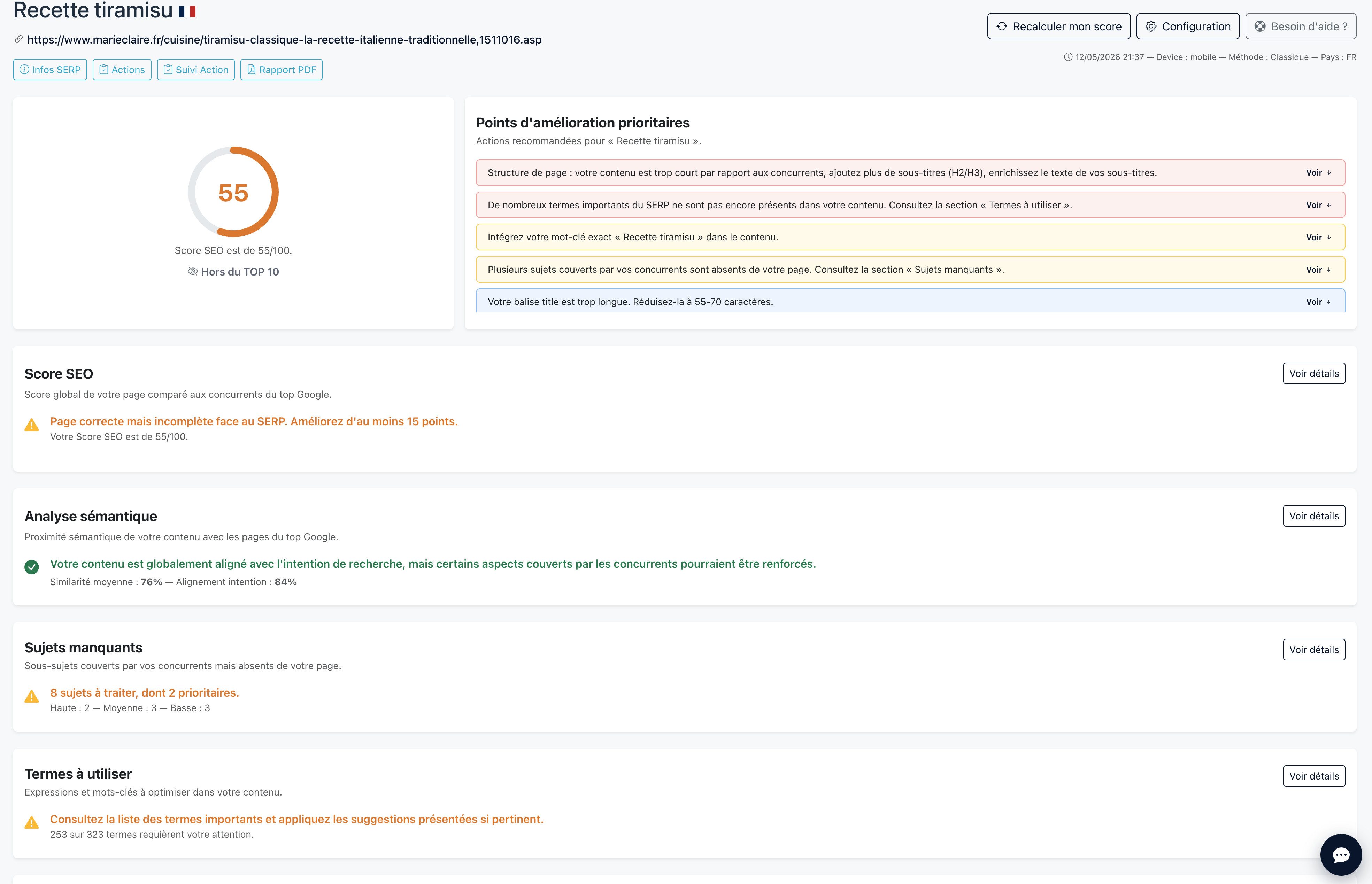
Verdict: Semrush wins on the overall technical audit of a full site (crawl, sitemap, robots, redirect chains, and so on). Horusium wins on auditing a single page against its SERP competition, with a directly actionable deliverable.
SEO writing based on SERP analysis
Semrush offers the SEO Writing Assistant (real-time analysis of your text) and ContentShake AI (article generation from a topic). Both are effective but stay generalist: they give a readability score and suggest a few terms, but real-time semantic analysis of the SERP isn't their strong suit.
Horusium produces a complete article, structured in H1/H2/H3, from a keyword. The tool first analyzes the SERP for the target keyword, extracts the salient terms, the topics covered by the ranking pages and the dominant editorial structure, then drafts an optimized draft. At the end, you get the article in a WYSIWYG editor, with an optimization score /100 and an optimization panel listing the terms to include, the topics to cover, and the pages to link from your own site.
Verdict: Horusium is more complete and more directly usable to produce an article from scratch. Semrush stays relevant if you just want an assistant to annotate your existing draft.
SEO health via Google Search Console
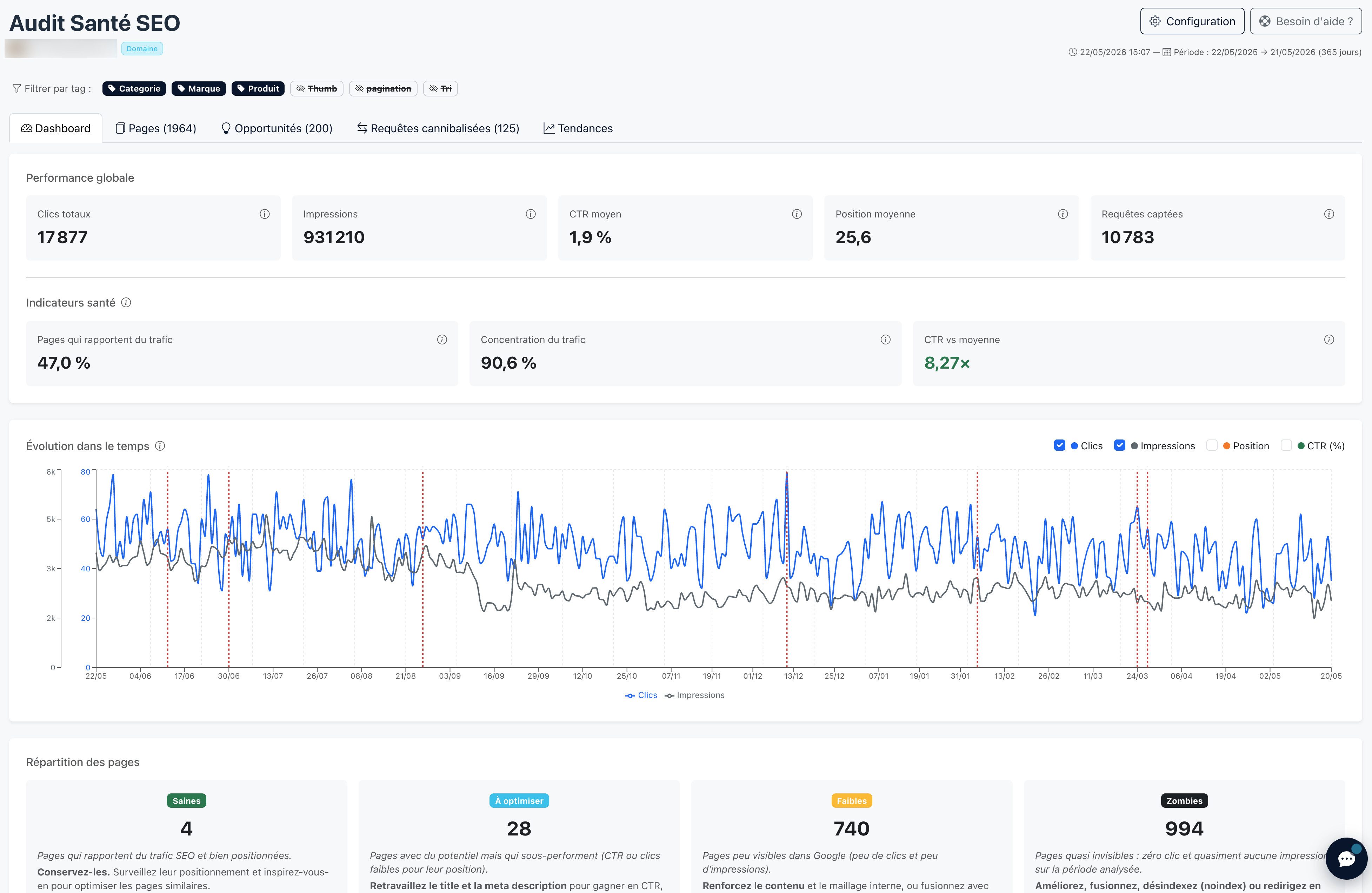
This is one of Horusium's signature modules, and it has no direct equivalent at Semrush. You connect your Google Search Console account in two clicks, run an audit over 90, 180 or 365 days, and Horusium delivers:
- A map of all your pages with an SEO value score /100 per page;
- Detection of zombie pages (pages that bring nothing and drag the site down);
- Detection of cannibalization (several URLs on the site competing for the same queries), with a risk score and a recommended URL to keep;
- A list of query opportunities (underused, scattered, or low CTR for a good position);
- A trends view (top 50 growing URLs, top 50 declining) on clicks, impressions or position.
Semrush offers GSC integrations, but not an analysis this advanced around cannibalization and query opportunities calibrated to the size of the site.
Verdict: Horusium clearly wins on this scope, which has become decisive in 2026 (mature sites no longer need so much to “create content” as to “clean up and clarify”).
SEO action tracking
Semrush offers projects and rank tracking, but no dedicated module for documenting the optimizations you carry out and their impact on your Google Search Console curves.
Horusium includes an Action Tracking module that is fully free (no credits consumed): for each optimization you carry out (title rewrite, content addition, redirect, internal-linking change, and so on), you create an entry with date, URL, target query and description. The actions then appear on the page's GSC curve, which lets you literally visualize the before/after. Ideal for making the value of your SEO work tangible to a client or to management.
Verdict: advantage Horusium, and it's free.
Backlinks and link building
Here, no debate: Semrush wins, and by a wide margin. Its database of 43 trillion links, its toxicity score, its prospecting tool and its competitive link-profile analysis features are a market benchmark. If your core business is active link building (link acquisition, disavow, competitor profile analysis), Semrush is more relevant.
Horusium includes referring domains in a page's audit, with a comparison to the competitors ranking on your keyword. But it's not a link-building prospecting tool as such.
Verdict: Semrush wins. For pure content SEO, it's probably not your number one criterion.
Feature summary table
To bring it all together:
| Feature | Semrush | Horusium |
|---|---|---|
| Keyword research (volume, intent, questions) | Excellent (25B+) | Very complete |
| Full technical site audit (crawl) | Yes (140+ checks) | No (page-by-page focus) |
| SEO audit of a page vs its SERP (score, action plan) | Partial | Yes (8 modules, prioritized plan) |
| SEO article writing based on the SERP | Yes (SEO Writing Assistant, ContentShake AI) | Yes (complete article + optimization) |
| GEO writing (visibility in generative engines) | No | Yes (dedicated module) |
| SEO health via Google Search Console (zombies, cannibalization) | Partial | Yes (signature module) |
| SEO action tracking with impact on GSC curves | No | Yes (free) |
| Large-scale backlink analysis | Excellent (43T+) | Included in the audit (limited) |
| Daily rank tracking | Yes | No |
| Google Ads / PPC | Yes (complete) | No |
| Social media management | Yes | No |
| 100% French interface | Partial | Yes |
| Native multi-language analysis (FR, EN, IT, DE, ES) | English first, other languages less mature | 5 languages with a dedicated analysis engine per language |
| Before/after PDF report for clients | Yes (generic reports) | Yes (per audit, client logo) |
The big difference: pricing and the business model
This is probably where 80% of the decision is made for an independent SEO or a small team. The two models are radically different.
Semrush: monthly subscription, all or nothing
| Semrush plan | Monthly price | Annual price (≈) |
|---|---|---|
| Pro | $139.95 | ~€1,545 |
| Guru | $249.95 | ~€2,760 |
| Business | $499.95 | ~€5,520 |
You pay every month, whether you use the tool 2 hours or 200. For an agency running at full capacity, it pays off. For a freelancer or a site that only needs a few optimizations a month, it's a budget that's hard to justify.
Horusium: credits that never expire, pay for what you use
| Horusium pack | Credits | Price | Cost per credit |
|---|---|---|---|
| Essential | 60 | €59 | ~€0.98 |
| Pro | 260 | €199 | ~€0.77 |
| Agency | 600 | €399 | ~€0.67 |
| Expert | 2,000 | €999 | ~€0.50 |
1 credit = 1 SEO audit or 1 SEO/GEO piece of writing. 1 credit = 5 keyword searches. Credits never expire. When you sign up, you get a free credit plus 3 keyword searches.
The math is easy. With a Horusium Pro pack at €199, you have 260 credits, which is enough to run:
- 260 page SEO audits, or
- 260 articles written and optimized, or
- 1,300 keyword searches, or
- any mix of the three.
The same budget at Semrush Pro (~€199) gets you... a single month of use, after which you have to top up again.
When does Semrush become more cost-effective?
If you're an agency running several hundred audits / pieces of writing a month, plus a real need for PPC, social and large-scale backlinks, a Semrush subscription can become more economical. Below that volume, Horusium stays structurally more advantageous.
Which tool for which profile?
Rather than crowning a single “winner”, here's a decision grid based on your profile.
You're an independent SEO consultant in France (or Europe) → Horusium
You work in French, English, Italian, German or Spanish — Horusium natively analyzes your content in these 5 languages, with a dedicated analysis engine per language (not just a swap of stop-words on an English engine). You bill per audit or by package, you need a clean deliverable (PDF report, action plan) and a tool you pay for as you use it. Horusium ticks every box.
You manage a site that already has SEO traffic → Horusium
If your site has been around for 2-3 years and already has data in Google Search Console, the SEO Health module will surface problems invisible to the naked eye (zombie pages, cannibalizing queries, poorly exploited query opportunities). That's often where the biggest traffic gains are hiding.
You're an agency with multiple needs (SEO + PPC + Social) → Semrush
If you handle Google Ads, social, dozens of clients at once and need a single platform with user accounts, massive rank tracking and broad competitive analysis, Semrush remains the benchmark tool.
You want to test before committing → Horusium
The free credit you get at sign-up lets you run a real complete audit or a complete piece of writing without spending a cent, and without even giving your bank details. Semrush offers a free trial limited to 7 days, which requires a card the moment you sign up.
Combining the two?
That's also a valid option. Semrush for broad competitive research and rank tracking, Horusium for page-by-page audits, SEO/GEO writing and site health via GSC. Many mature SEOs work exactly like this.
Conclusion
Semrush and Horusium don't really fight on the same ground. Semrush is a massive all-in-one marketing platform with a monthly subscription that suits intensive, professional use across several disciplines (SEO + PPC + social + backlinks). Horusium is a content SEO and site health platform, in French — with native language analysis in 4 other European languages (English, Italian, German, Spanish) — and a pay-as-you-go model aimed at freelancers, small publishers, and companies that want to steer their SEO without committing to an annual subscription.
The other difference, more subjective but one that weighs on the daily routine: Semrush is a factory. Too complete, too complex, too many tools 80% of which you'll never use, a dense interface that takes hours of training just to avoid getting lost. Horusium makes the opposite bet: keep only the essentials, the tools that are genuinely useful for moving your SEO forward. The interface is deliberately guided — at each step, you know exactly what to do and where to start. A Horusium audit means reading a score, following a prioritized action plan, and approving a piece of writing. No training needed to get going.
If we had to sum it up in one sentence: Semrush is broader, Horusium is more precise, simpler and more flexible. Depending on the profile, one or the other will stand out — and in quite a few cases, the two can coexist.